
Projected Is Not Actual
A projected release date is a planning date. It can be a prison time-computation estimate, a parole eligibility date, an estimated mandatory release date, or an estimated sentence discharge date. It is not the same as the moment a person physically walks out of Conejos County Jail or a CDOC facility. The actual release can depend on final paperwork, a court order, a detainer, a parole plan, another hold, or a sentence recalculation.
For Conejos County Jail, no official public release calendar or jail good-time rule was located in the research sweep. A person in local custody on a pending case may be released after bond, a personal recognizance order, dismissal, sentence completion, time served, probation sentencing, or transfer. That person may never have a CDOC projected date. For a local jail sentence, the controlling sources are the sentencing order, any jail-credit entry, the sheriff or jail calculation, and the Conejos Combined Court record.
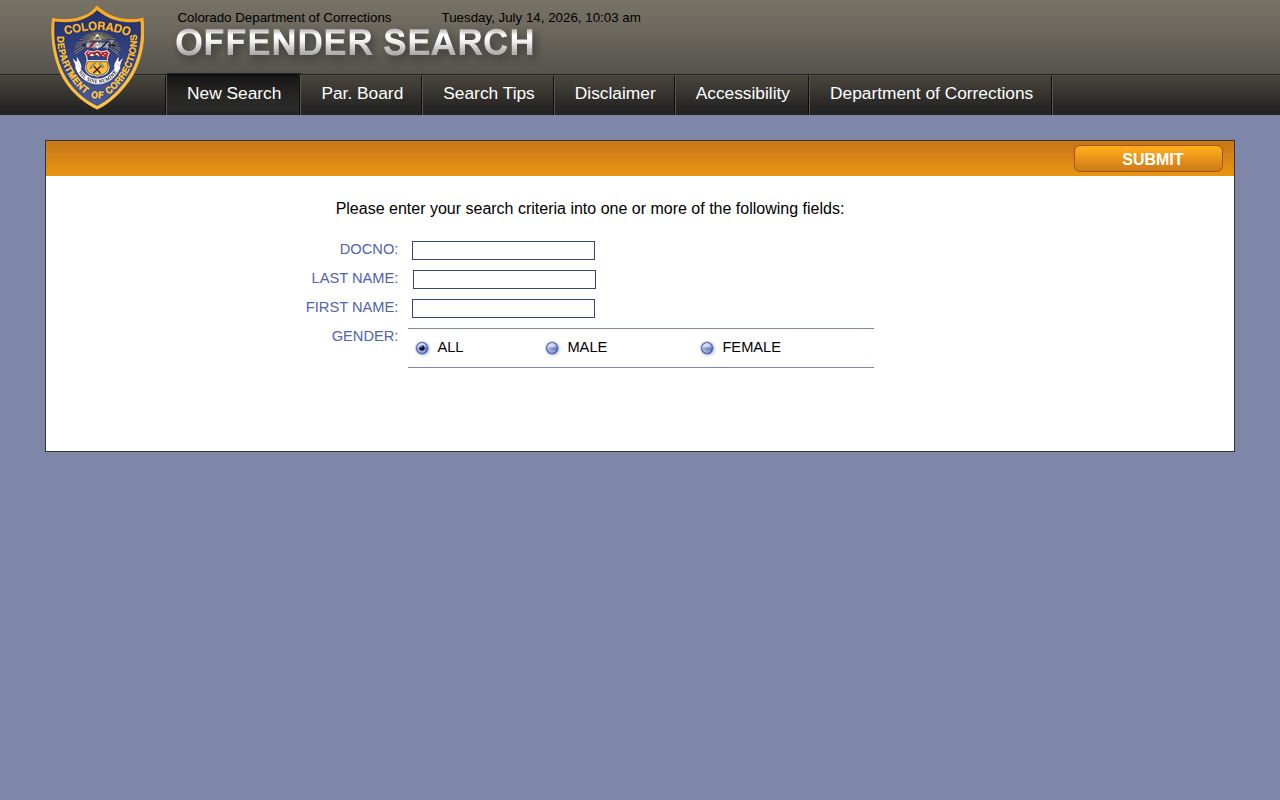
For Colorado prison custody, the CDOC offender search is the main public starting point. CDOC profiles are built around state prison custody and sentence timing. Public examples show fields such as estimated parole eligibility date, next parole hearing date, estimated mandatory release date, and estimated sentence discharge date. Those labels should be read as CDOC sentence fields, not as a Conejos County Jail release notice.
Find a Projected Date
Use a sequence that matches the custody type. The wrong system can create false certainty. CDOC is useful when a Conejos case ended in a felony prison sentence, when the court docket shows a mittimus to the Department of Corrections, when the person is on parole, or when a state sentence is being discharged. CDOC is not the right first source for a person who only spent time in the Conejos County Jail on a misdemeanor, pretrial case, municipal matter, or short jail sentence.
- Get the Conejos case number, booking date, sentencing date, or DOC number if available.
- Decide whether the person is in local jail custody, state prison custody, parole, probation, federal custody, or immigration custody.
- For CDOC, search by DOCNO first because CDOC identifies offenders primarily by DOC number.
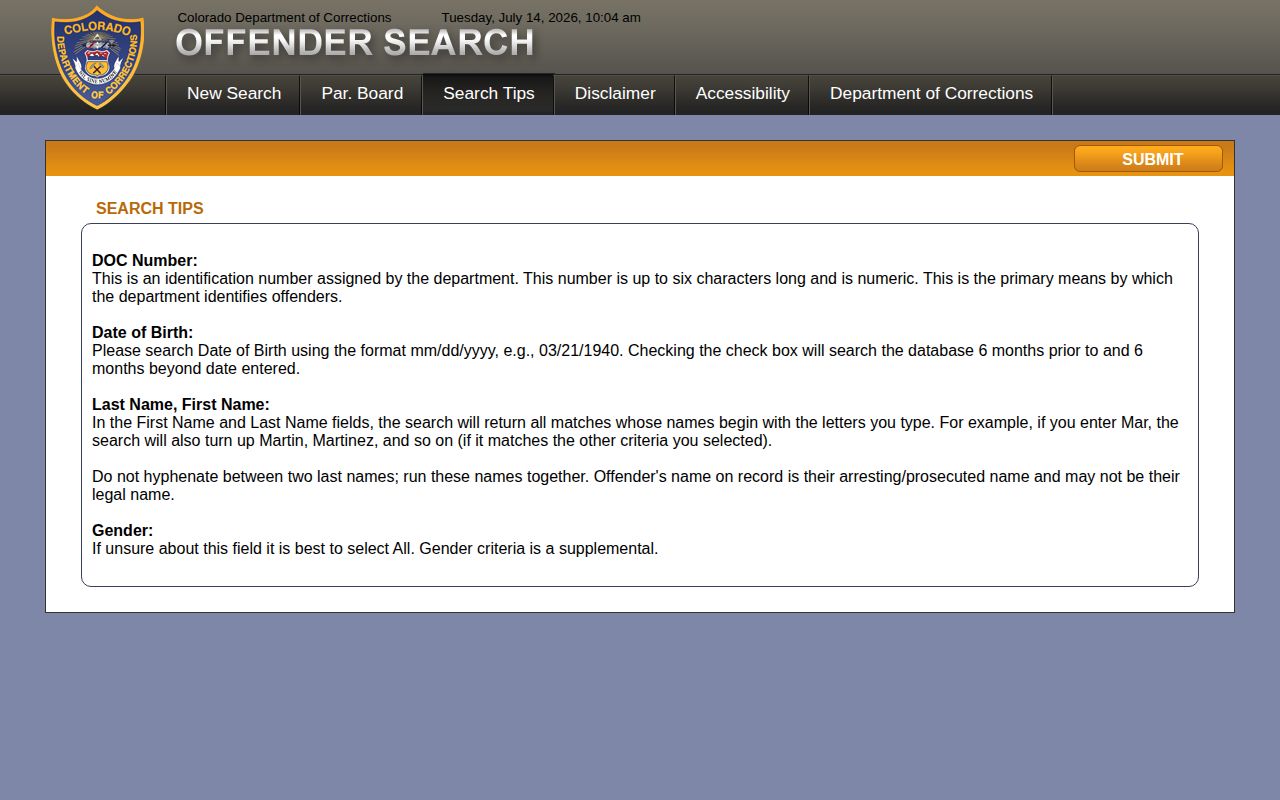
- If the DOC number is unknown, search by last name and first name, including prosecuted-name and spelling variants.
- Open the profile and record the exact CDOC labels, including parole eligibility, hearing, mandatory release, and sentence discharge fields.
- Check the parole-board calendar if the question is about board review rather than sentence discharge.
- For a Conejos jail sentence, call the jail at 719-376-2196 and confirm against the court sentencing order or release record.
The Colorado Judicial Branch docket search is often the bridge between jail and prison records. It can point to bond, disposition, sentencing, probation, jail credit, warrant recall, or a mittimus. Conejos Combined Court lists phone 719-376-5465 and email conejosclerk@judicial.state.co.us. If the court record shows a prison sentence, move to CDOC. If it shows probation, bond, dismissal, or a county jail sentence, stay with the court and sheriff path.
CDOC Date Fields
CDOC does not necessarily use the single phrase "projected release date." The public profile structure is more specific. A parole eligibility date means the person can be considered under the governing sentence and statute. A next parole hearing date is a board event, not a guaranteed release date. An estimated mandatory release date is a release-to-parole point for many determinate sentences if parole was not granted earlier. An estimated sentence discharge date is the projected end of the sentence and may be later than physical release because parole can continue after a person leaves prison.
| CDOC field | What it means |
|---|---|
| Est. Parole Eligibility Date | The first or next point when parole consideration may be available under Colorado law and the sentence calculation. |
| Next Parole Hearing Date | A scheduled board review. The result can be grant, denial, deferment, tabled action, or further investigation. |
| Est. Mandatory Release Date | A projected release-to-parole point for many determinate sentences, subject to law, credits, holds, and sentence structure. |
| Est. Sentence Discharge Date | The estimated end of the sentence, which can include supervision time after physical prison release. |
CDOC's disclaimer warns that public database information can be inaccurate and should be confirmed with CDOC. For a Conejos County reader, the safest use is to copy the exact field labels and dates from the profile, compare them with the Conejos court record, and request official CDOC confirmation when an exact time calculation is needed.
Parole Calendar Context
The Colorado State Board of Parole calendar is part of the CDOC offender-search application at the parole-board calendar page. It publishes monthly calendars and daily schedule views. A calendar listing is useful because it tells you a board event is scheduled or expected, but it is not a release order. The board may grant parole, deny parole, defer review, table the case for more information, require a parole-plan investigation, or rescind a grant before release if circumstances change.
For Conejos County, use the parole calendar only after confirming the person is in the state-prison path. A county-jail detainee without a prison sentence is usually a bond, court, probation, or jail-record question, not a parole-board question. If the court record shows a mittimus to CDOC, then the parole calendar, CDOC profile, and CDOC records channels can be read together. If the court record shows probation or a local jail sentence, the parole calendar will not explain the local release timing.
Colorado Earned Time Rules
Colorado's general parole-eligibility statute is C.R.S. 17-22.5-403. The ordinary rule for many felony sentences is parole eligibility after fifty percent of the sentence imposed, less time authorized for earned time, but the statute contains many exceptions. Violent offenses, offense-date rules, prior convictions, sex offenses, habitual cases, and sentence structures can change the calculation. A Conejos page should not apply one percentage to every prisoner.
Earned time is governed by C.R.S. 17-22.5-405. The statute ties earned time to progress in work and training, group living, counseling or program participation, and related case-management criteria. Earned time is not automatic. It can be unavailable, limited, denied, removed, restored, or recalculated. Some violent-offense rules limit when earned time affects parole eligibility or release timing.
Proposition 128 added a modern Colorado truth-in-sentencing rule for certain crimes of violence. The Colorado 2024 Blue Book explains that, for covered crimes committed on or after January 1, 2025, the measure increases the time that must be served before discretionary parole eligibility or earned-time reductions, including an 85% threshold. A third crime of violence can require service of the full sentence before parole. That rule is offense-date-specific and offense-specific, so it should be checked against the exact conviction and sentence rather than assumed from the county name or charge summary.
Conejos Jail Calculations
County jail release calculation is separate from CDOC earned time. A person sentenced to a short Conejos County Jail term may have presentence confinement credit, court-ordered credit, local jail procedures, or work-time/good-time handling, but no Conejos County jail good-time policy was found in the research. Do not import CDOC earned-time rules into the county jail. The jail sentence may also be affected by a hold from another county, probation warrant, federal agency, immigration agency, or transfer order.
For a local jail sentence, ask for the release calculation through the Conejos County Sheriff's Office or jail records process. Use the sentencing order and any jail-credit language from Conejos Combined Court to check the calculation. If staff cannot provide details by phone, request the record of official action documenting release from custody and ask for the booking number, release date and time, release reason, bond or court order connection, and transfer agency if any.
This difference matters most when a person disappears from a jail lookup. In Conejos County, no official online current roster or recent-release feed was confirmed, so absence from an online source is not a release calculation. It may reflect the absence of a public feed, a transfer, a sealed record, a spelling mismatch, or a system that never included the booking.
Why Dates Move
Projected dates change because the underlying sentence record changes or because a later event affects release. The table below separates common causes so a Conejos County user can decide which office to contact.
| Change factor | Where to verify |
|---|---|
| New jail-credit order or amended mittimus | Conejos Combined Court and CDOC if the sentence is to prison. |
| Earned time awarded, denied, removed, or restored | CDOC time-computation or records channels. |
| Parole grant, denial, deferment, or rescission | CDOC offender profile and Colorado State Board of Parole calendar or follow-up. |
| Detainer, hold, new warrant, or new charge | Sheriff release record, court docket, CDOC profile, or receiving agency. |
| Sentence aggregation, resentencing, appeal, or correction | Court record first, then CDOC for prison calculations. |
| Administrative release processing or parole-plan review | CDOC or the supervising parole authority, depending on the case. |
Confirm Before Acting
Use VINELink Inmate Search for alerts, but use the record owner for proof. For Conejos County Jail, call 719-376-2196 or submit a Colorado Criminal Justice Records Act request for the release record. For a court order, bond, probation sentence, mittimus, or sentence completion entry, use Conejos Combined Court. For a state prison projected date or discharge, use CDOC. For a federal or immigration transfer, use BOP, USMS, ICE, or EOIR as appropriate.
The careful question is not only "when is the release date?" It is "which system controls the release?" A bond release, probation sentence, state-prison parole date, mandatory release, sentence discharge, transfer to another agency, and sealed court event are not interchangeable. Keeping those categories separate is the best way to avoid a wrong Conejos County release conclusion.
If the public sources conflict, privilege the source with authority over the event. The sheriff controls the local jail release record. The court controls orders, sentence entries, and mittimus documents. CDOC controls prison time computation and state parole processing. VINE provides notice, but it does not decide the release date. That chain is especially important in Conejos County because no official online rolling release list was confirmed.
Public Record Search
Sponsored Results